
Decabrand pillar guide
Healthcare Search Visibility
Build discoverability around the way patients actually search, rather than treating rankings as the final outcome.
The short answer
What is healthcare search visibility?
Healthcare search visibility is the practice of making a provider discoverable, understandable, and credible wherever a patient researches care: local results, organic search, AI-generated answers, directories, and branded search. The goal is not a ranking by itself. It is qualified discovery that leads to a staffed, measurable next step. Strong visibility comes from technically accessible pages, accurate local entities, specific service information, useful first-party expertise, corroborating reputation signals, and a clear path from the answer to the practice.
The strategic tension
A practice can rank for a phrase and still be hard to choose. Search visibility only becomes useful when the listing, page, and proof answer the patient's next question and make the next step obvious.
Build discoverability around the way patients actually search, rather than treating rankings as the final outcome.
What this topic will help you do
- Distinguish discoverability from rankings
- Connect local, organic, and AI search signals
- Measure whether visibility produces reachable demand
A useful place to begin
Questions worth answering before choosing a tactic
Can a patient find the right location and service without knowing your exact brand name?
Do your search listings lead to a staffed, measurable next step?
Does each important service have evidence that a search engine or answer engine can retrieve?
Are you measuring qualified calls and bookings, or only positions and impressions?
The Decabrand operating model
The discover–verify–choose framework
A useful search program follows the patient’s decision sequence. It does not begin with a list of keywords or a promise to appear in an AI answer.
Decision visual
Modern healthcare search is a set of connected pathways
One patient need can move through search results, local listings, AI answers and human recommendations before the practice ever receives a visit or call.
Patient need or question
Symptoms, service, location, cost, trust or access
Google results
Pages, ads and rich results answer and route demand
Maps and local
Proximity, availability, reputation and entity facts shape choice
AI answers
Systems synthesize sources and may cite, summarize or omit the practice
Human referrals
Clinicians, patients and communities create trusted entry points
One source of truth: services · clinicians · locations · evidence · access · current availability
01
Make the right entity discoverable
Establish one consistent account of the practice, locations, clinicians, services, and service areas across the website, Google Business Profile, major directories, and trusted third-party sources. Create a distinct page only when a service or location represents a genuinely different patient decision—not to manufacture near-duplicate inventory.
02
Answer the question behind the query
A patient searching a condition, procedure, price, recovery question, or ‘near me’ phrase needs a different answer. Build pages around those decisions, state the answer plainly, and support it with the qualifications, constraints, evidence, and next steps a cautious patient would need. Important information should remain available as crawlable text even when diagrams or video make it easier to understand.
03
Create corroboration, not schema theater
Structured data can clarify what a page describes, but it cannot substitute for visible evidence. Keep markup consistent with the page, use specific supported types, and connect claims to real clinicians, locations, policies, sources, and proof. AI and search systems are more likely to retrieve information that is explicit, internally consistent, and supported beyond a single promotional sentence.
04
Measure the journey after visibility
Track qualified calls, appointment requests, booked visits, and service-line fit alongside impressions and rankings. Review the landing page, phone response, scheduling availability, and source attribution together. A visibility gain that sends patients to an unclear page or an unanswered phone is not a search success.
From guidance to execution
Relevant Decabrand expertise
Use the guide to diagnose the decision first. If execution is the constraint, these are the services most directly connected to this topic.
For the complete operating system, read the Healthcare Practice Growth Guide.
Recommended reading path
Start here
These are not simply the newest articles. Read them in order to establish the decision framework before moving into narrower applications.
Step 1
Local SEO Isn't About Rankings. It's About Reachable Care.Begin with the outcome: whether local discovery produces a call the practice can actually answer.
November 19, 2025 · 5 min read
Step 2
AI Visibility Is a Retrieval Problem, Not a Ranking PromiseThen understand why clear, retrievable evidence matters more than promises of an AI ranking.
November 5, 2025 · 5 min read
Step 3
Google Business Profiles for Healthcare: What We Know in 2026Use the Google Business Profile guide to translate that thinking into local-search operations.
May 21, 2026 · 4 min read
Questions this guide answers
Frequently asked questions
Is AEO or GEO separate from SEO?
Not in the way it is often sold. Search and generative systems still need accessible, indexable, useful content and trustworthy entity signals. AEO and GEO add emphasis on explicit answers, retrievable passages, corroboration, and measurement across answer surfaces, but they do not replace technical SEO, helpful content, or real-world authority.
Does adding more schema make a practice appear in AI answers?
No. Structured data can help systems interpret visible information, but there is no special AI-results schema and no guarantee of inclusion. Mark up only what the page actually shows, use the most specific applicable type, and invest first in information quality and consistency.
What should a healthcare practice measure beyond rankings?
Measure qualified calls and forms, contact-to-booking rate, booked-patient fit, location and service-line demand, response time, and the pages or search experiences that assisted the decision. Rankings and AI mentions are diagnostic signals, not the business outcome.
The full collection
Explore every published article in this topic

Ask an Assistant Who the Best Practice in Your City Is. Then Read the Answer Properly.
A ten second test any practice owner can run without a vendor, and a guide to the four things the answer tells you. Most owners have never checked, which is usually why the answer is someone else.

Healthcare Local SEO Ranking Factors: Evidence Before Tactics
Prioritize healthcare local SEO with Google's published factors, accurate location data, useful pages, genuine reputation and measurable patient access.
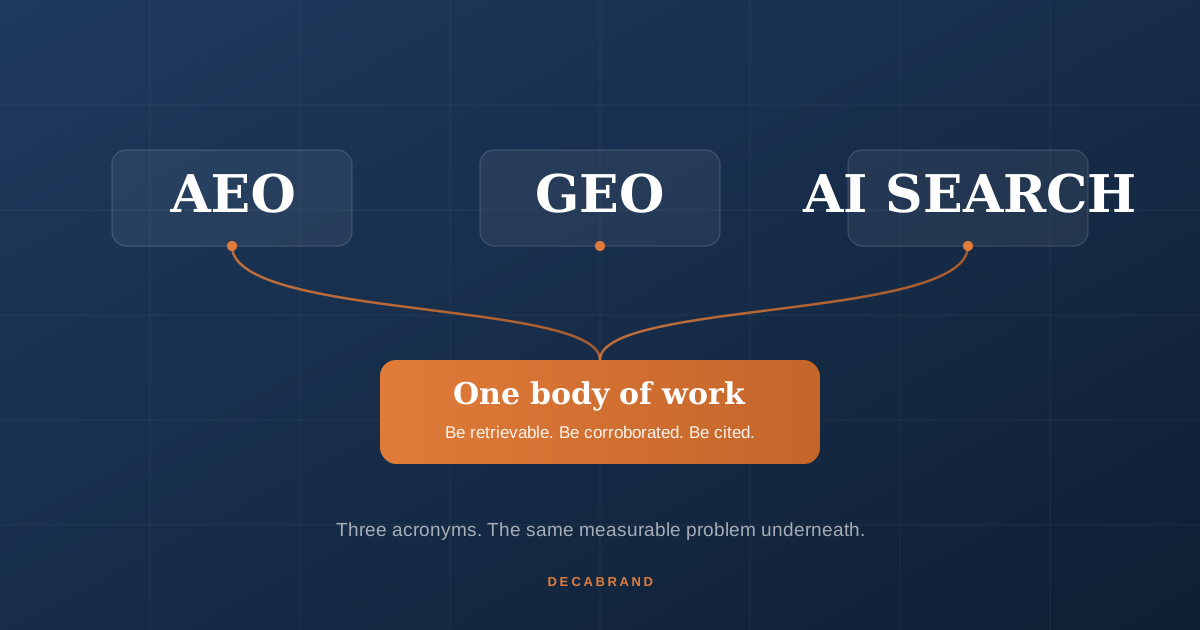
AEO, GEO, AI Search: Which of These Terms Actually Means Anything
Three acronyms describe roughly the same work, and the market has not settled on any of them. What matters is not the label a vendor uses but whether they can tell you where your practice stands today.

Google Business Profiles for Healthcare: What We Know in 2026
Google does not publish a secret local algorithm recipe. Healthcare practices can still act on relevance, distance, prominence, accurate representation and patient access.

What ‘Near Me’ Healthcare Marketing Really Requires
Hyperlocal healthcare marketing is not city-name repetition. It aligns truthful location information, service availability and a workable patient journey.

Multi-Location Dental Marketing Is an Operating Model
Dental groups do not need a choice between central consistency and local relevance. They need clear ownership of facts, access, reputation and demand by location.
Med Spa SEO Fails When It Optimizes the Keyword Instead of the Decision
Med spa search strategy should help an appropriate local patient evaluate a real treatment and provider. Rankings are useful only when the page resolves that decision responsibly.

Healthcare Search in 2026: Design for the Next Decision
Patients can encounter a practice through Google results, maps, AI-generated answers and human referrals. The durable strategy is evidence that helps the next decision.

Local SEO Isn't About Rankings. It's About Reachable Care.
Local healthcare SEO should be judged by whether appropriate patients can find, contact and reach the practice—not by a ranking screenshot alone.
AI Visibility Is a Retrieval Problem, Not a Ranking Promise
A practice cannot optimize its way to a guaranteed ChatGPT recommendation. It can make accurate public information discoverable, support important claims, and measure how answer systems represent it.

Google Business Profile Problems That Actually Cost a Practice
A healthcare profile can fail without violating a secret ranking rule. The costly problems are usually inaccurate facts, mismatched services, broken actions, unmanaged change, and weak measurement.